6 Ways an Ownership Culture Goes Beyond Compliance in Construction

Every construction company has rules, procedures and standards. They think that having these artifacts of compliance will keep their people safe.
But many companies end up making their people less safe. They create a compliance focus that undermines the team’s ability to make good choices.
Stop nurturing a compliance-mindset in your business. You should focus on creating an ownership-mindset. Enable your team to think independently about their safety.
However, it’s not entirely obvious how to nurture an ownership-mindset – if it were, everyone would do it.
In this article, you will learn differences between compliance vs ownership mindset. In doing so, you’ll have a better way in shaping the culture your company needs.
1. Compliance vs Ownership Culture: Improved Safety Performance
In many compliance cultures, people follow the rules when supervisors are present. When nobody is looking, they go back to old habits and bad behaviors.
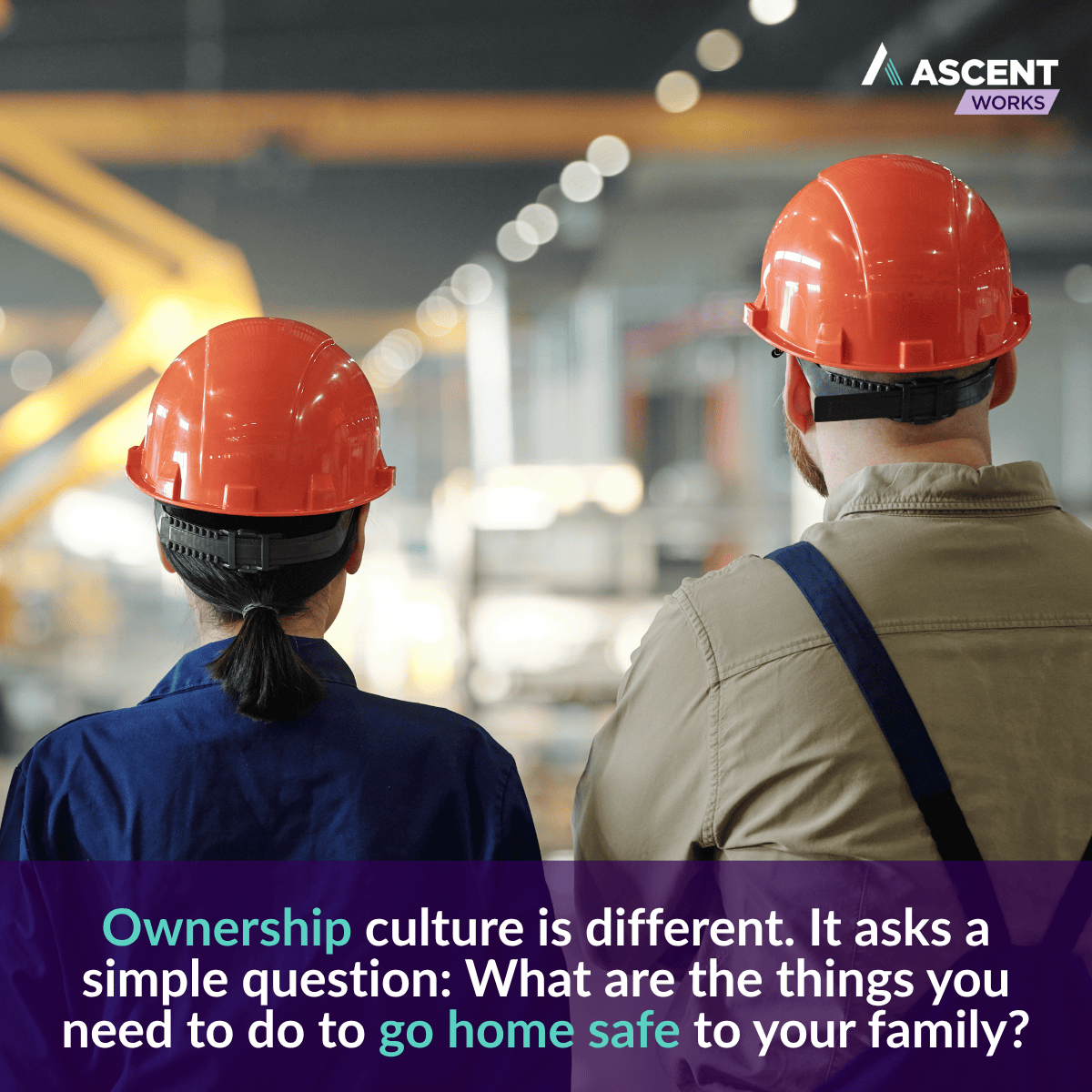
But ownership culture is different. It asks a simple question: What are the things you need to do to go home safe to your family?
ViaSun Corporation is one of Ascent Works top performing clients. They had safety programs, training, and policies, and a strong compliance culture.
The company was doing the things needed to meet requirements and check the boxes.
The stakes were much higher than compliance. Their goal was to make sure every employee went home safe to their family.
But a risk assessment revealed that a workplace fatality was possible. The possibility forced leadership to confront an uncomfortable truth. Policies and procedures alone do not save lives.
So ViaSun changed the conversation. Safety stopped being about keeping OSHA happy and became a promise to their people.
The question changed. “What do you have to do?” became, “What are the things you need to do to go home safe to your family?”
Safety became something employees expected from themselves and each other.
Employee-owners held themselves accountable because they cared about the outcome.
ViaSun Corporation achieved more than 750,000 hours without a lost-workday injury. They maintained critical behavior safety scores above 97 percent.
When people feel trusted and empowered, they do the right thing no matter who’s looking.
2. How Ownership Culture Drives Greater Innovation
Construction companies need defined expectations. Results are rarely achieved when people feel constrained by compliance alone.
Results improve when you:
- Allow people to be part of the process
- Define what is critical
- Clarify what defines success.
In compliance-driven cultures, employees often wait for instructions. They become reluctant to share ideas. They are afraid of making mistakes or stepping outside the rules.
Over time, people stop thinking like problem-solvers. They start focusing on doing only required work.
Leaders must give their people the ability to think like owners. Ownership creates trust. It gives employees the freedom to make decisions within a clear framework.
As a result, people feel included and invested in the outcome. They feel trusted and empowered.
They identify better ways to work and solve problems sooner. Also, they suggest improvements that leaders may never see.
People feel pride when they get to make decisions and do not need permission for every action. Innovation does not come from tighter control.
It comes from the environment where people think, contribute, and act like owners.
3. Building Psychological Safety Through Ownership
Employees need to feel comfortable speaking up, sharing concerns, and giving feedback.
Psychological safety does not exist in a culture built on “because I told you so” or “because you have to.”
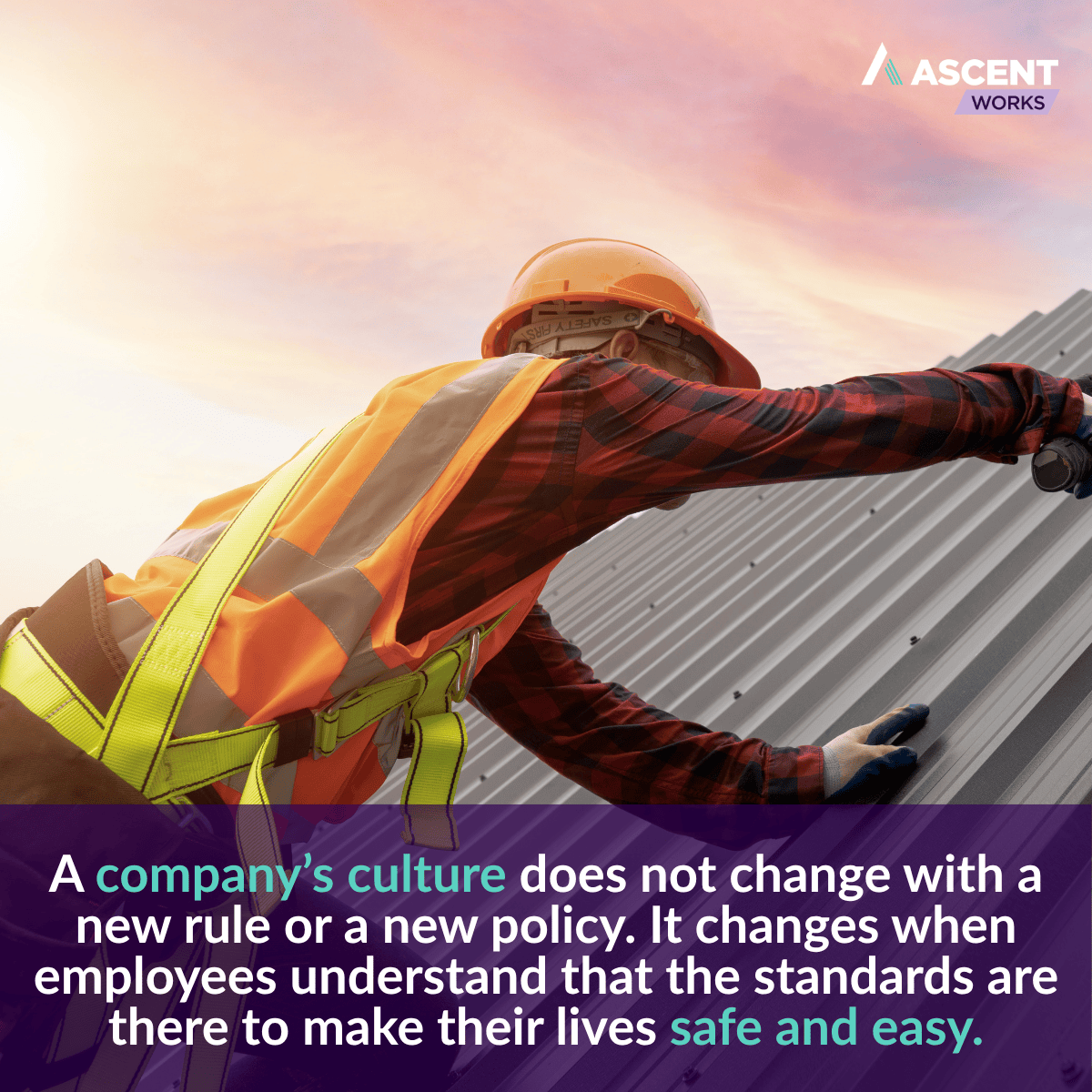
A large roofing contractor in Arizona I worked with had safety policies in place.
Federal OSHA has fall protection standards that require employees to wear harnesses and tie off.
The compliance piece was clear. The stakes were even clearer because people’s lives were on the line. Every employee deserved to go home safe to their family at the end of the day.
But culture does not change with a new rule or a new policy. Asking roofers to all of a sudden wear harnesses and tie off created a cultural shock.
The company could have taken a hammer approach. They could told people, “Because you have to.”
Instead, leaders recognized that compliance alone would create resistance. The more they pushed on the compliance piece, the more employees pushed back.
So they focused on the why.
They built trust first. They helped employees understand that the standards were not there to make their lives difficult.
They were there because their lives mattered. They talked about the people waiting at home. Their kids, grandkids, spouses, and families expected them to come back safely.
The change did not happen overnight. It took a long time, and leaders had to be okay with not being great for a while.
But as employees connected safety to their personal motivators, adoption improved. They began to own the outcome because they cared about it.
That is the difference between compliance and ownership. Compliance tells people what they have to do. Ownership gives them a reason to do it.
4. How Ownership Culture Enables Faster Decision Making
Decisions made in the field can affect people, projects, and customers. Leaders need teams that can respond fast because work rarely goes exactly as planned.
But decision-making slows down when people have to ask for permission for every action.
When you empower people and build trust, they make good decisions to impact the business.
Those decisions may seem small on their own. But when you multiply them over several moments every day, they create significant value. That is what I call the ripple effect.
A leading home builder and multi-family contractor we worked with, saw this ripple effect firsthand. The company gave leaders and employees greater ownership over safety and risk. The team joined hands to:
- Improve driver safety behaviors by 70%
- Reduced its EMOD from 1.24 to 0.74, and
- Cut Claims Severity Rate by 70%.
Those improvements did not come from one big decision. They came from hundreds of better decisions made every day by people closest to the work.
The result was more than safer operations. It helped the company save more than $800,000 in annual insurance premiums.
If you can get buy-in from the 80 percent of people doing the work in the field, you can do anything.
Because when people think like owners, decisions happen faster. The benefits ripple throughout the entire business.
I also believe in simple frameworks. Steve Tusa calls it “the power of three.”
Nobody remembers a 300-page manual. But almost everyone can remember three principles.
As long as employees know the few things that matter most, they can make good decisions.
The framework can be simple.
- Is it safe?
- Is it good for the customer?
- Does it make sense?
If the answer is yes, then why not? The “power of 3” approach creates speed.
Employees no longer waited for leaders to solve every problem.
They understood the expectations. They made decisions within the framework, and kept work moving forward safely.
5. Ownership Culture Builds Client Trust and Reputation
Construction companies need strong safety cultures. Customers expect projects to be completed safely, on time, and without disruption.
Every contractor wants a reputation for reliability.
But one serious incident can change that reputation overnight.
When someone gets injured on a job site, the consequences spread fast.
There are direct costs, such as claims and rising insurance costs.
Then there are indirect costs. The job stops. Schedules get delayed. Resources must be pulled from another project to finish the work.
The damage does not stop there. Reputation suffers too. Good news travels fast, but bad news travels at lightning speed.
In construction, news of a serious incident can spread like wildfire. Customers hear about it. Competitors talk about it and confidence begins to erode.
So organizations must build a culture of ownership, not just compliance.
When employees take ownership of safety and accountability, incidents become less likely. So, projects run more consistently.
Customers experience fewer delays and fewer disruptions. They see a contractor that protects its people and delivers on its commitments.
Because clients do not simply remember the work you completed.
They remember whether they could trust you to complete it without unwanted surprises.
6. How Ownership Culture Increases Productivity
Construction companies need productive teams and employees need clear expectations. Every project depends on people doing the work well.
But compliance often produces the bare minimum. People do what is required because the rules say they have to.
So leaders must build ownership. When people feel empowered and trusted, you’re going to get more output than bare minimum.
Trust gives people “the ability to think for themselves” and “the ability to think like an owner.”
Productivity increases when people stop asking, “What do I have to do?” and start asking, “How can I help us succeed?”
Bottom Line: Moving Beyond Compliance to Ownership Culture
Compliance is not enough to drive strong outcomes as it creates minimum standards.
People follow rules when they are watched, and often revert to habits when they are not.
Ownership changes that dynamic entirely. When employees act like owners rather than rule-followers, safety becomes personal, not procedural.
People ask different questions: not “What do I have to do?” but “What do I need to do to protect myself, my team, and my work?”
That shift drives stronger safety performance, faster decisions, better problem-solving, and higher engagement.